

What Conclusion Can You Draw About Doris Lessing After Reading Through The Tunnel?
| Doris Lessing CH OMG | |
|---|---|
 Lessing at the Lit. Cologne literary festival in 2006 | |
| Born | Doris May Tayler (1919-ten-22)22 October 1919 Kermanshah, Iran |
| Died | 17 November 2013(2013-11-17) (aged 94) London, England |
| Pen proper noun | Jane Somers |
| Occupation | Author |
| Nationality | British |
| Period | 1950–2013 |
| Genre |
|
| Literary movement |
|
| Notable works |
|
| Notable awards |
|
| Spouse | Frank Charles Wisdom (m. 1939; div. 1943) Gottfried Anton Nicolai Lessing (chiliad. 1943; div. 1949) |
| Children |
|
| Website | |
| dorislessing | |
Doris May Lessing CH OMG (née Tayler; 22 October 1919 – 17 November 2013) was a British-Zimbabwean (Rhodesian) novelist. She was built-in to British parents in Iran, where she lived until 1925. Her family unit so moved to Southern Rhodesia (now Zimbabwe), where she remained until moving in 1949 to London, England. Her novels include The Grass Is Singing (1950), the sequence of 5 novels collectively called Children of Violence (1952–1969), The Golden Notebook (1962), The Proficient Terrorist (1985), and five novels collectively known as Canopus in Argos: Athenaeum (1979–1983).
Lessing was awarded the 2007 Nobel Prize in Literature. In application the prize, the Swedish Academy described her as "that epicist of the female person experience, who with scepticism, fire and visionary power has subjected a divided civilization to scrutiny".[ii] Lessing was the oldest person ever to receive the Nobel Prize in Literature.[three] [4] [five]
In 2001, Lessing was awarded the David Cohen Prize for a lifetime'south achievement in British literature. In 2008, The Times ranked her 5th on a listing of "The 50 greatest British writers since 1945".[6]
Life [edit]
Early life [edit]
Lessing was built-in Doris May Tayler in Kermanshah, Iran, on 22 Oct 1919, to Captain Alfred Tayler and Emily Maude Tayler (née McVeagh), both British subjects.[seven] Her begetter, who had lost a leg during his service in World War I, met his futurity wife, a nurse, at the Royal Gratis Hospital in London where he was recovering from his amputation.[8] [9] The couple moved to Iran, for Alfred to take a job equally a clerk for the Royal Bank of Persia.[10] [11]
In 1925, the family moved to the British colony of Southern Rhodesia (now Zimbabwe) to farm maize and other crops on about 1,000 acres (400 ha) of bush that Alfred bought. In the crude environment, his wife Emily aspired to atomic number 82 an Edwardian lifestyle. It might have been possible had the family been wealthy; in reality, they were short of money and the subcontract delivered very little income.[12]
Equally a girl Doris was educated get-go at the Dominican Convent Loftier School, a Roman Catholic convent all-girls school in the Southern Rhodesian capital letter of Salisbury (now Harare).[13] Then followed a year at Girls High School in Salisbury.[fourteen] She left school at historic period 13 and was self-educated from then on. She left home at 15 and worked as a nursemaid. She started reading textile that her employer gave her on politics and sociology[9] and began writing around this time.
In 1937, Doris moved to Salisbury to work as a telephone operator, and she soon married her offset husband, civil servant Frank Wisdom, with whom she had ii children (John, 1940–1992, and Jean, born in 1941), before the marriage ended in 1943.[9] Lessing left the family dwelling in 1943, leaving the two children with their father.[one]
Motion to London; political views [edit]
After the divorce, Doris's interest was fatigued to the customs around the Left Book Lodge, an arrangement she had joined the yr before.[12] [fifteen] It was here that she met her time to come second married man, Gottfried Lessing. They married presently after she joined the group, and had a child together (Peter, 1946–2013), before they divorced in 1949. She did not marry again.[nine] Lessing also had a love matter with RAF serviceman John Whitehorn (brother of journalist Katharine Whitehorn), who was stationed in Southern Rhodesia, and wrote him ninety messages between 1943 and 1949.[16]
Lessing moved to London in 1949 with her younger son, Peter, to pursue her writing career and socialist beliefs, merely left the two older children with their male parent Frank Wisdom in South Africa. She later said that at the time she saw no choice: "For a long time I felt I had done a very brave matter. There is nada more than irksome for an intelligent woman than to spend countless amounts of time with small children. I felt I wasn't the best person to bring them up. I would accept ended upwards an alcoholic or a frustrated intellectual similar my female parent."[17]
Also as campaigning against nuclear artillery, she was an agile opponent of apartheid, which led her to being banned from South Africa and Rhodesia in 1956 for many years.[18] In the same year, following the Soviet invasion of Republic of hungary, she left the British Communist Political party.[xix] In the 1980s, when Lessing was vocal in her opposition to Soviet actions in Afghanistan,[xx] she gave her views on feminism, communism and science fiction in an interview with The New York Times.[10]
On 21 August 2015, a five-book secret file on Lessing built upwards by the British intelligence agencies, MI5 and MI6, was made public[21] and placed in The National Archives. The file, which contains documents that are redacted in parts, shows Lessing was nether surveillance by British spies for effectually twenty years, from the early on-1940s onwards. Her associations with Communism and her anti-racist activism are reported[22] to be the reasons for the secret service interest in Lessing.
Literary career [edit]
At the historic period of fifteen, Lessing began to sell her stories to magazines.[23] Her first novel, The Grass Is Singing, was published in 1950.[12] The work that gained her international attention, The Golden Notebook, was published in 1962.[11] By the time of her expiry, she had published more than than 50 novels, some under a pseudonym.[24]
In 1982 Lessing wrote two novels under the literary pseudonym Jane Somers to bear witness the difficulty new authors face in trying to get their work printed. The novels were rejected by Lessing'south U.k. publisher simply later accepted by another English publisher, Michael Joseph, and in the Usa past Alfred A. Knopf. The Diary of a Good Neighbour [25] was published in Britain and the U.s.a. in 1983 and If the Old Could in both countries in 1984,[26] both as written by Jane Somers. In 1984 both novels were republished in both countries (Viking Books publishing in the U.s.a.), this time under one cover, with the championship The Diaries of Jane Somers: The Diary of a Good Neighbour and If the Old Could, list Doris Lessing every bit author.[27]
Lessing declined a damehood (DBE) in 1992 every bit an honour linked to a non-existent Empire; she had declined an OBE in 1977.[28] Later she accustomed date as a Companion of Honour at the end of 1999 for "conspicuous national service".[29] She was also made a Companion of Literature by the Royal Club of Literature.[30]
In 2007 Lessing was awarded the Nobel Prize in Literature.[31] She received the prize at the historic period of 88 years 52 days, making her the oldest winner of the literature prize at the time of the honor and the third-oldest Nobel laureate in whatever category (afterward Leonid Hurwicz and Raymond Davis Jr.).[32] [33] She was also just the eleventh adult female to be awarded the Nobel Prize for Literature by the Swedish Academy in its 106-yr history.[34] In 2017, just ten years later, her Nobel medal was put up for auction.[35] [36] Previously only one Nobel medal for literature had been sold at auction, for André Gide in 2016.[36]
Lessing was out shopping for groceries when the Nobel Prize announcement came. Arriving home to a gathering of reporters she exclaimed, "Oh Christ!"[37] "I've won all the prizes in Europe, every encarmine ane, and then I'm delighted to win them all. It's a purple affluent."[38] She entitled her Nobel Lecture On Not Winning the Nobel Prize and used it to describe attention to global inequality of opportunity and to suggest that fiction writers tin can be involved in redressing those inequalities. Lessing wrote that "it is our imaginations which shape united states, continue united states of america, create us – for good and for sick. It is our stories that will recreate us, when nosotros are torn, hurt, fifty-fifty destroyed."[39] The lecture was subsequently published in a limited edition to raise money for children made vulnerable by HIV/AIDS. In a 2008 interview for the BBC'south Front Row she stated that increased media interest after the honor had left her without time or free energy for writing.[40] Her final volume, Alfred and Emily, appeared in 2008.
Illness and decease [edit]
During the late-1990s Lessing suffered a stroke,[41] which stopped her from travelling during her later years.[42] She was however able to attend the theatre and opera.[41] She began to focus her mind on expiry, for example request herself if she would have fourth dimension to cease a new volume.[18] [41] She died on 17 November 2013, aged 94, at her home in London, predeceased by her two sons, but was survived by her daughter, Jean, who lives in South Africa.[43]
She was remembered with a humanist funeral service.[44]
Fiction [edit]
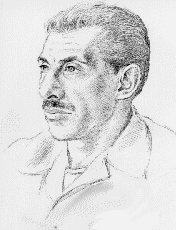
Lessing's fiction is ordinarily divided into three singled-out phases.
During her Communist stage (1944–56) she wrote radically about social issues, a theme to which she returned in The Expert Terrorist (1985). Doris Lessing'south get-go novel, The Grass Is Singing, too every bit the brusk stories later collected in African Stories, are set in Southern Rhodesia (today Zimbabwe) where she was then living.[ citation needed ]
This was followed by a psychological phase from 1956 to 1969, including the Golden Notebook and the "Children of Violence" quartet.[ citation needed ]
Tertiary came the Sufi stage, explored in her 70s work, and in the Canopus in Argos sequence of scientific discipline fiction (or as she preferred to put it "space fiction") novels and novellas.[ citation needed ]
Lessing'due south Canopus sequence received a mixed reception from mainstream literary critics. John Leonard praised her 1980 novel The Marriages Between Zones Three, Iv and V in The New York Times,[46] but in 1982 John Leonard wrote in reference to The Making of the Representative for Planet 8 that "[o]ne of the many sins for which the 20th century will exist held accountable is that it has discouraged Mrs. Lessing... She at present propagandises on behalf of our insignificance in the catholic razzmatazz,"[47] to which Lessing replied: "What they didn't realise was that in science fiction is some of the best social fiction of our fourth dimension. I too adore the classic sort of science fiction, like Blood Music, by Greg Bear. He's a great writer."[48] She attended the 1987 World Science Fiction Convention every bit its Writer Guest of Honor. Here she made a speech in which she described her dystopian novel Memoirs of a Survivor as "an attempt at an autobiography."[49]
The Canopus in Argos novels present an avant-garde interstellar society'southward efforts to advance the evolution of other worlds, including Earth. Using Sufi concepts, to which Lessing had been introduced in the mid-1960s by her "good friend and instructor" Idries Shah,[45] the series of novels besides uses an approach similar to that employed by the early 20th century mystic G. I. Gurdjieff in his piece of work All and Everything. Earlier works of "inner space" fiction like Briefing for a Descent into Hell (1971) and Memoirs of a Survivor (1974) likewise connect to this theme. Lessing's interest had turned to Sufism afterwards coming to the realisation that Marxism ignored spiritual matters, leaving her disillusioned.[l]
Lessing'southward novel The Golden Notebook is considered a feminist classic by some scholars,[51] but notably not by the author herself, who afterward wrote that its theme of mental breakdowns every bit a ways of healing and freeing 1's self from illusions had been disregarded past critics. She also regretted that critics failed to appreciate the exceptional structure of the novel. She explained in Walking in the Shade that she modelled Molly partly on her practiced friend Joan Rodker, the daughter of the modernist poet and publisher John Rodker.[52]
Lessing did not similar being dove-holed every bit a feminist author. When asked why, she explained:
What the feminists want of me is something they haven't examined because it comes from religion. They want me to deport witness. What they would really similar me to say is, 'Ha, sisters, I stand with you side past side in your struggle toward the gilded dawn where all those beastly men are no more.' Do they really want people to make oversimplified statements about men and women? In fact, they do. I've come up with cracking regret to this conclusion.
Doris Lessing Society [edit]
The Doris Lessing Society is dedicated to supporting the scholarly study of Lessing's work. The formal structure of the Society dates from January 1977, when the commencement issue of the Doris Lessing Newsletter was published. In 2002 the Newsletter became the academic journal Doris Lessing Studies. The Gild also organises panels at the Modern Languages Association (MLA) almanac Conventions and has held two international conferences in New Orleans in 2004 and Leeds in 2007.[53]
Archives [edit]
Lessing's literary archive is held by the Harry Bribe Humanities Research Middle, at the University of Texas at Austin. The 45 archival boxes of Lessing's materials at the Ransom Eye contain nearly all of her extant manuscripts and typescripts upwardly to 1999. Original textile for Lessing's early on books is assumed not to be because she kept none of her early manuscripts.[54] The McFarlin Library at the University of Tulsa holds a smaller collection.[55]
The University of East Anglia's British Archive for Gimmicky Writing holds Doris Lessing'southward personal archive: a vast collection of professional and personal correspondence, including the Whitehorn letters, a collection of honey letters from the 1940s, written when Lessing was still living in Zimbabwe (and so Southern Rhodesia). The drove also includes forty years of personal diaries. Some of the archive remains embargoed during the writing of Lessing'due south official biography.[56]
Awards [edit]
- Somerset Maugham Award (1954)
- Prix Médicis étranger (1976)
- Austrian State Prize for European Literature (1981)
- Shakespeare-Preis der Alfred Toepfer Stiftung F. 5. S., Hamburg (1982)
- WH Smith Literary Award (1986)
- Palermo Prize (1987)
- Premio Internazionale Mondello (1987)
- Premio Grinzane Cavour (1989)
- James Tait Black Memorial Prize for biography (1995)
- Los Angeles Times Volume Prize (1995)
- Premi Internacional Catalunya (1999)[57]
- Order of the Companions of Honour (1999)
- Companion of Literature of the Royal Society of Literature (2000)
- David Cohen Prize (2001)
- Premio Príncipe de Asturias (2001)
- Due south.T. Dupont Gilded PEN Honour (2002)[58]
- Nobel Prize in Literature (2007)
- Order of Mapungubwe: Category II Gold (2008)[59]
Publications [edit]
Novels [edit]
Opera libretti [edit]
Comics [edit]
Drama [edit]
Poetry collections [edit]
| Brusk story collections [edit]
Autobiography and memoirs [edit]
Other non-fiction [edit]
|
See likewise [edit]
- List of female person Nobel laureates
- Failing a British honor
References [edit]
- ^ a b Stanford, Peter (22 November 2013). "Doris Lessing: A mother much misunderstood". The Daily Telegraph. Archived from the original on 12 Jan 2022. Retrieved 8 October 2019.
- ^ "NobelPrize.org". Retrieved 11 Oct 2007.
- ^ Crown, Sarah (xi October 2007). "Doris Lessing wins Nobel prize". The Guardian . Retrieved 18 March 2022.
- ^ Editors at BBC. "Author Lessing wins Nobel laurels", BBC News, 23 October 2007. Retrieved 12 October 2007.
- ^ Marchand, Philip. "Doris Lessing oldest to win literature laurels". Toronto Star, 12 Oct 2007. Retrieved 13 October 2007.
- ^ (5 Jan 2008). "The 50 greatest British writers since 1945". Archived from the original on 25 April 2011. Retrieved 17 April 2008. . The Times. Retrieved 25 April 2011.
- ^ Hazelton, Lesley (11 Oct 2007). "Golden Notebook' Writer Lessing Wins Nobel Prize". Bloomberg. Archived from the original on 24 October 2013. Retrieved eleven October 2007.
- ^ Carole Klein. "Doris Lessing". The New York Times . Retrieved 11 October 2007.
- ^ a b c d Liukkonen, Petri. "Doris Lessing". Books and Writers (kirjasto.sci.fi). Finland: Kuusankoski Public Library. Archived from the original on viii June 2008.
- ^ a b c Hazelton, Lesley (25 July 1982). "Doris Lessing on Feminism, Communism and 'Space Fiction'". The New York Times . Retrieved 11 Oct 2007.
- ^ a b "Author Lessing wins Nobel honour". BBC News. 11 October 2007. Retrieved 11 October 2007.
- ^ a b c "Biography". A Reader's Guide to The Golden Notebook and Under My Pare. HarperCollins. 1995. Retrieved 11 October 2007.
- ^ Carol Simpson Stern. Doris Lessing Biography. biography.jrank.org. Retrieved 11 Oct 2007.
- ^ Lessing, Doris (1994). Under My Skin: Volume One of My Autobiography, to 1949 . London: Harper Collins. p. 147. ISBN000255545X.
- ^ Cursory Chronology. A Abode for the Highland Cattle & The Antheap. Broadview Press. 2003. ISBN9781551113630 . Retrieved 29 December 2010.
- ^ Flood, Alison (22 Oct 2008). "Doris Lessing donates revelatory letters to academy". The Guardian.
- ^ "Lowering the Bar. When bad mothers give us hope" Archived 30 Apr 2015 at the Wayback Machine, Newsweek, six May 2010. Retrieved 9 May 2010.
- ^ a b Peter Guttridge (17 November 2013). "Doris Lessing: Nobel Prize-winning author whose work ranged from social and political realism to scientific discipline fiction". The Independent . Retrieved 17 November 2013.
- ^ Miller, Stephen (17 November 2013). "Nobel Author Doris Lessing Dies at 94". The Wall Street Journal . Retrieved 23 Nov 2013.
- ^ "Doris Lessing blows the veil of romanticism off Afghanistan", The Christian Science Monitor, fourteen January 1988.
- ^ Shirbon, Estelle, "British spies reveal file on Nobel-winner Doris Lessing", Reuters, 21 August 2015.
- ^ Norton-Taylor, Richard, "MI5 spied on Doris Lessing for 20 years, declassified documents reveal", The Guardian, 21 August 2015.
- ^ Lessing, Doris. "Biography (From the pamphlet: A Reader's Guide to The Golden Notebook & Under My Skin, HarperPerennial, 1995)".
- ^ Kennedy, Maev (17 Nov 2013). "Doris Lessing dies aged 94". The Guardian.
- ^ "The Diary of a Good Neighbour by Doris Lessing". Doris Lessing. Retrieved 13 August 2012.
- ^ "If the Sometime Could by Doris Lessing". www.dorislessing.org.
- ^ Hanft, Adam. "When Doris Lessing Became Jane Somers and Tricked the Publishing World (And Mayhap Herself In the Procedure)". The Huffington Mail, x November 2007. Updated 25 May 2011. Retrieved seven September 2017.
- ^ Flood, Alison (22 October 2008). "Doris Lessing donates revelatory messages to academy". The Guardian . Retrieved fifteen October 2012.
- ^ "Doris Lessing interview". BBC Radio. Archived from the original (Sound) on 14 October 2007. Retrieved xi October 2007.
- ^ "Companions of Literature list". Archived from the original on 7 July 2007. Retrieved 11 October 2007.
- ^ Rich, Motoko and Lyall, Sarah. "Doris Lessing Wins Nobel Prize in Literature". The New York Times. Retrieved 11 October 2007.
- ^ Hurwicz won the Nobel Memorial Prize in Economic Science in 2007 anile ninety. Davis received the 2002 Physics Prize at 88 years 57 days. Their birth dates are shown in their biographies at the Nobel Prize web site, which states that the awards are given annually on 10 December.
- ^ Pierre-Henry Deshayes. "Doris Lessing wins Nobel Literature Prize". Herald Sun. Retrieved 16 Oct 2007.
- ^ Reynolds, Nigel. "Doris Lessing wins Nobel prize for literature". The Telegraph. Retrieved 15 October 2007.
- ^ "Valuable Books and Manuscripts". Cristies. xiii Dec 2017. Retrieved 7 December 2017.
- ^ a b Alison Flood (7 December 2017). "Doris Lessing'due south Nobel medal goes upward for auction". The Guardian . Retrieved 7 December 2017.
- ^ "Lessing's Legacy of Political Literature", CBS News, 12 October 2007.
- ^ Hinckley, David. "Doris Lessing wins Nobel Prize for Literature". Daily News (New York). Retrieved fifteen October 2007.
- ^ "The Nobel Prize in Literature 2007". NobelPrize.org . Retrieved 24 April 2019.
- ^ "Lessing: Nobel win a 'disaster'". BBC News. xi May 2008. Retrieved 11 May 2008.
- ^ a b c Raskin, Jonah (June 1999). "The Progressive Interview: Doris Lessing". The Progressive (reprint). dorislessing.org. Retrieved 17 November 2013.
- ^ Helen T. Verongos (17 November 2013). "Doris Lessing, Novelist Who Won 2007 Nobel, is Expressionless at 94". The New York Times . Retrieved 17 November 2013.
- ^ "Author Doris Lessing dies aged 94", BBC. Retrieved 17 Nov 2013.
- ^ "Humanists UK launches get-go ever funeral tribute archive". Humanists Uk. 24 April 2018. Retrieved 23 October 2010.
- ^ a b Lessing, Doris. "On the Death of Idries Shah (excerpt from Shah's obituary in the London The Daily Telegraph)". dorislessing.org. Retrieved 3 October 2008.
- ^ https://www.nytimes.com/1980/03/27/archives/books-of-the-times-gentle-book.html Retrieved 24 December 2020.
- ^ Leonard, John (vii February 1982). "The Spacing Out of Doris Lessing". The New York Times . Retrieved 16 October 2008.
- ^ Doris Lessing: Hot Dawns, interview by Harvey Blume in Boston Book Review
- ^ "Guest of Honor Speech", in Worldcon Invitee of Honor Speeches, edited past Mike Resnick and Joe Siclari (Deerfield, IL: ISFIC Press, 2006), p. 192.
- ^ "Postcolonial Nostalgias: Writing, Representation and Memory", Volume 31 of Routledge enquiry in postcolonial literatures, Dennis Walder, Taylor & Francis ltd, 2010, p92. ISBN 9780203840382.
- ^ "Fresh Air Remembers 'Gilded Notebook' Author Doris Lessing". NPR. 18 November 2013. Retrieved nineteen November 2013.
- ^ Scott, Lynda, "Lessing's Early on and Transitional Novels: The Beginnings of a Sense of Selfhood", Deepsouth, vol. iv, no. 1 (Autumn 1998). Retrieved 17 Oct 2007.
- ^ "Doris Lessing Society". Doris Lessing Society.
- ^ "Harry Ransom Eye Holds Archive of Nobel Laureate Doris Lessing". hrc.utexas.edu. Retrieved 17 March 2008.
- ^ "Doris Lessing manuscripts". lib.utulsa.edu. Retrieved 17 October 2007.
- ^ "Doris Lessing Archive". University of Tulsa. Retrieved v July 2016.
- ^ "Memòria del Departament de Cultura 1999" (PDF) (in Catalan). Generalitat de Catalunya. 1999. p. 38. Retrieved 17 Nov 2013.
- ^ "Gilt Pen Award, official website". English language PEN. Retrieved 3 December 2012.
- ^ "National Orders Recipients 2008". South African History Online. 28 Oct 2008. Archived from the original on 22 January 2016. Retrieved 6 August 2018.
Further reading [edit]
- Diski, Jenny (2016). In gratitude. London, Britain: Bloomsbury Publishing. ISBN978-1-408-87992-4.
- Fahim, Shadia S. (1995). Doris Lessing: Sufi Equilibrium and the Form of the Novel. Basingstoke, United kingdom/New York, NY: Palgrave Macmillan/St. Martins Press. ISBN0-312-10293-3.
- Frick, Thomas (Spring 1988). "Doris Lessing, The Art of Fiction No. 102". The Paris Review. Leap 1988 (106).
- Galin, Müge (1997). Between East and W: Sufism in the Novels of Doris Lessing. Albany, NY: State Academy of New York Press. ISBN0-7914-3383-8.
- Raschke, Debrah; Sternberg Perrakis, Phyllis; Vocalizer, Sandra (2010). Doris Lessing: Interrogating the Times. Columbus, OH: Ohio State University Printing. ISBN978-0-8142-1136-half dozen.
- Ridout, Alice (2010). Contemporary Women Writers Look Back: From Irony to Nostalgia. London: Continuum International Publishing. ISBN978-1-4411-3023-five.
- Ridout, Alice; Watkins, Susan (2009). Doris Lessing: Border Crossings. London: Continuum International Publishing. ISBN978-one-4411-0416-eight.
- Skille, Nan Bentzen (1977). Fragmentation and Integration. A Critical Study of Doris Lessing, The Golden Notebook. Academy of Bergen.
- Watkins, Susan (2010). Doris Lessing. Manchester Up. ISBN978-0-7190-7481-3.
- Wolfe, Graham (2019). Theatre-Fiction in Britain from Henry James to Doris Lessing: Writing in the Wings. Routledge. ISBN9781000124361.
External links [edit]

Source: https://en.wikipedia.org/wiki/Doris_Lessing
Posted by: phillipsboild1989.blogspot.com
0 Response to "What Conclusion Can You Draw About Doris Lessing After Reading Through The Tunnel?"
Post a Comment